
House of Tinsel · The dressing ritual
Drape Guide
The art of wearing your mekhela sador.
Considered for your look
Xurai Jurun Mekhela Sador
Two separate pieces, one graceful silhouette. Prepare the mekhela first, then let the sador frame its weaving. Family and regional draping preferences may differ; this is a practical starting point.
Before you begin: fitted blouse, comfortable underskirt, occasion shoes, a full-length mirror and help from your dresser if needed. Use pins sparingly; avoid piercing delicate handwork.

A measured sequence
From the first fold to the final fall.
Prepare the two pieces
Lay out the mekhela and the separate sador. The mekhela must be joined into a tube before wearing; if yours arrives as an open length, have a tailor finish it first. Check the sador’s edges and identify the decorative end.
A mekhela sador is not a single-length saree. [1]
Set the mekhela’s length
Put on your fitted blouse, comfortable underskirt and occasion shoes. Step into the mekhela tube and lift its upper edge to your waist. Adjust the lower border evenly so it clears the floor when you walk.
Set the hem with the shoes you will actually wear.
Shape the front folds
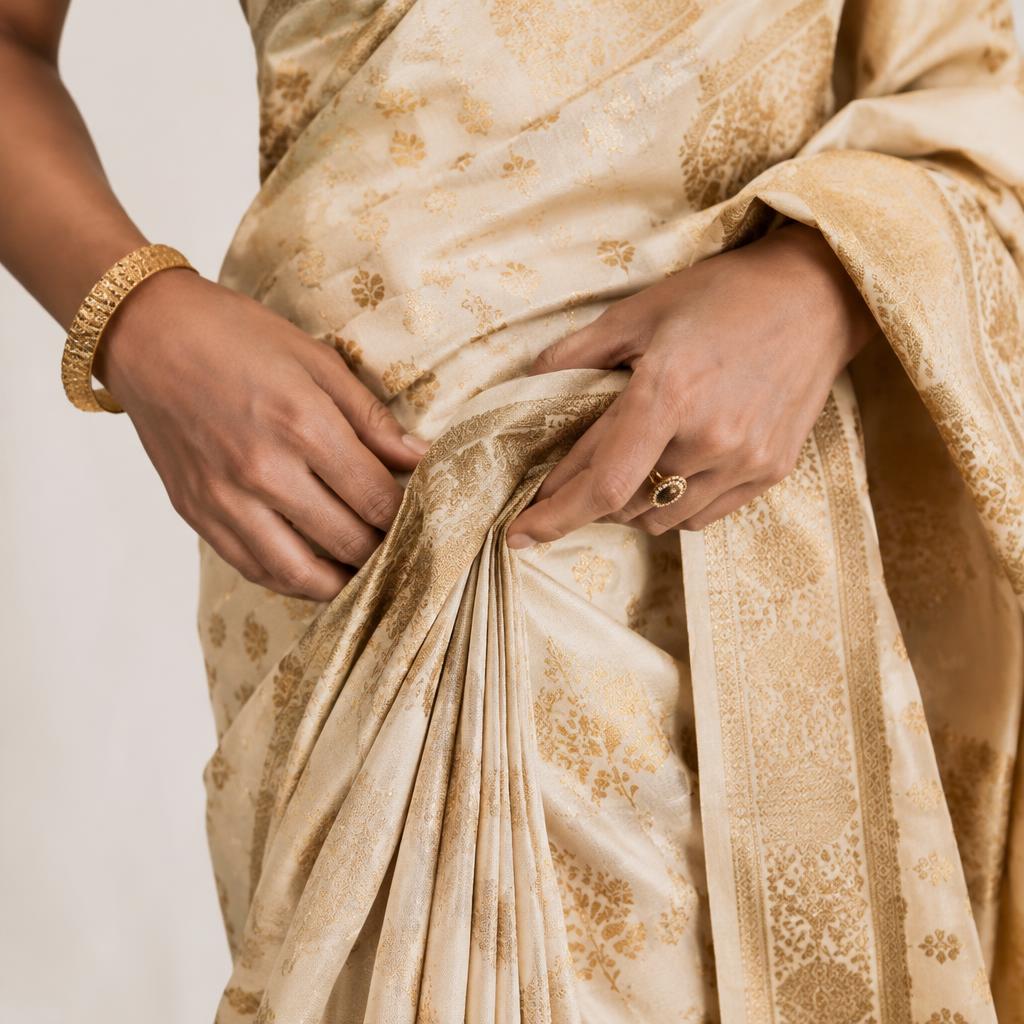
Gather the excess width into a few broad, even folds at the front. Align the woven border, smooth each fold with your hands and tuck the upper edges securely into the underskirt waistband without pulling the silk taut.
Fold direction and placement vary; follow your family’s drape or your dresser’s guidance.
Anchor the sador
Tuck a short section of the plain end at your waist, commonly on the right. Bring the remaining length around your back, then across the front of your body. Keep enough ease to sit and breathe comfortably.
Do not wrap the upper cloth tightly around the waist.
Let the border lead
Bring the decorative end over the left shoulder. Arrange it in soft, even folds or leave it more open to reveal the weaving. Adjust the length behind you to suit your height and occasion; let the border lie flat across the front.
Rehearse any family-specific ceremonial arrangement with your dresser.
Secure, then move
If a pin is needed, ask your dresser to secure the shoulder discreetly, avoiding dense handwork and delicate woven motifs. Check every pin is closed. Walk, sit and lift your arms; readjust folds or the hem if anything catches or pulls.
Never force a pin through embroidery or use adhesive on silk.
The last check
Poise begins with comfort.
The hem should clear the floor, the waistband should feel secure without pressure, and the shoulder should allow free movement. If the weave pulls or a pin catches, stop and ask your dresser to adjust it. Your silk should move with you.
Discuss your look with the House